7 AI Tools That Read Customer Reviews in 2026


Table of Content:
- Key insights
- What does AI that reads customer reviews actually do?
- App reviews, product reviews, and customer feedback need different analysis
- The Benefits of Using AI for Reading Customer Reviews
- Four mistakes that make AI review tools look better than they are
- What features should have an ideal AI Feedback Analysis tool
- 7 AI tools that read customer reviews: quick comparison
- How we compared the tools
- 7 Platforms Using AI to Analyze Customer Reviews
- Give every finalist the same 100 reviews
- How to turn AI review analysis into a product decision
- FAQ
- Final take
Updated November 9, 2026 · Reviewed by Yaroslav Rudnitskiy, ASO Lead at AppFollow · Originally published Aug 25, 2025
What changed in this update:
- Added Amplitude AI Feedback — a new entrant since November 2025.
- Refreshed pricing for all 7 tools (verified May 2026).
- New section: AI for product reviews vs. AI for app store reviews — what changes.
- New comparison methodology — the six criteria we used to review each tool.
A one-star review lands after Tuesday’s release: “Still paying. Can’t restore my subscription.” By Friday, more reviews mention billing, but the average rating has barely moved. If nobody is sorting the words behind those stars, the team is still debating whether it’s a payment bug or an angry outlier.
That’s the job of AI that reads customer reviews. It takes thousands of short, inconsistent comments and helps teams find the recurring issue, check the original reviews, and decide who should act. The useful output isn’t “sentiment: negative.” It’s a specific pattern, the reviews behind it, and a next step.
We compared seven options for different jobs: App Store and Google Play review operations, e-commerce product reviews, multi-location reputation monitoring, and company-wide customer feedback analysis. They do not solve the same problem. A tool built to reply to store reviews may be excellent at support operations and the wrong choice for unifying call transcripts with NPS comments.
Start with the comparison. Then use the evaluation checklist to test two finalists against your own review data. This guide draws on current product documentation and published capabilities; it is not a claim that all seven vendors were tested in one controlled lab.
Key insights
- For App Store and Google Play review queues, AppFollow is a strong fit when tagging, reply workflows, market filters, and follow-up reporting belong in the same process.
- For customer feedback spread across surveys, support, CRM, and app reviews, start with a cross-channel platform such as Medallia or Amplitude AI Feedback. Check actual source coverage before buying.
- For marketplace product reviews, compare Revuze and Yotpo on retailer coverage, SKU-level analysis, and what data each integration can legally access.
- A sentiment score alone is not an insight. Ask to see the original comments behind every theme and how the tool handles mixed feedback.
- Do not compare vendors by a claimed AI accuracy percentage unless they used the same labeled sample, languages, and category definitions.
- The fastest buying test: give each finalist 100 anonymized reviews, then compare whether it catches the problems your team would actually fix.
What does AI that reads customer reviews actually do?
It takes open-text reviews and turns them into evidence you can sort. The usual steps are: collect the text, identify sentiment, assign topics, group similar complaints, and show whether those topics are gaining or losing share. Some tools also draft replies or route urgent reviews to support and product teams.
Here’s a small example. “Love the design, but the latest update signed me out and won’t let me back in” is not just a negative review. It contains praise, an access failure, and a release-related clue. A useful AI tool should keep those details separate. When the same issue appears in more reviews from one market or app version, a PM can investigate instead of treating the entire review as a vague dip in satisfaction.
A summary is a starting point. The real test is whether you can open the source reviews, check the tags, and reproduce the decision.
App reviews, product reviews, and customer feedback need different analysis
An app-store review might say “crashes after the update.” A marketplace review might say “the charger works, but the package arrived damaged.” Both can be negative; they belong to different teams.
For mobile apps, keep store, country, date, rating, and available version or device details attached to the comment. You want to know whether login complaints cluster around a release, not just that “login” appears often.
For retail products, the useful dimensions are usually SKU, retailer, purchase context, delivery, fit, or product quality. Meanwhile, a CX team combining support conversations, surveys, calls, and reviews needs a common taxonomy across channels.
Choose the tool for the sources you actually own and the decisions you need to make. If a vendor claims to cover everything, ask for a live example from each required source and check what the integration can retrieve, not just what appears on the sales slide.
The Benefits of Using AI for Reading Customer Reviews
Analyzing customer reviews with AI is a whole next level for app developers and marketers. Who has time to waste hours (or even days!) trying to make sense of all that feedback? Let artificial intelligence handle the grunt work for you. Save yourself a ton of time AND dig deeper into what your customers are saying. Here's why using AI to read and analyze customer feedback is a no-brainer:
Time-saving
AI can blaze through thousands of reviews in a matter of minutes. Let's say you've got 10,000 customer reviews on your hands—going through them one by one would take forever and a day! With AI, the process is lightning-fast.
For example, app developers can scan their app store reviews in the blink of an eye, zero in on the most common issues, and get straight to fixing them. This frees up your time to focus on what really counts—making your app better instead of drowning in a sea of data.
Unbiased feedback analysis
Humans get tired. AI doesn't. It'll read every single review without missing a beat or getting all emotional about it. AI keeps it real, looking at both the good and the bad feedback without any bias.
For example, if users are repeatedly mentioning a certain bug, AI will pick up on it even if they’re feeling overwhelmed by other tasks.
Identifying trends
AI spots patterns and trends over time. For example, if a ton of users start complaining about "slow load times" or "frequent crashes," AI will flag those issues as the most common gripes. This helps app developers prioritize fixes or improvements that will help the most customers, making sure the app keeps evolving to meet user needs.
Real-time insights
With AI, you can keep your finger on the pulse of customer feedback 24/7.
Picture this: you just dropped a major update or a shiny new feature. AI instantly rounds up all the customer reactions, so you can see right away if your launch was a hit or needs some serious tweaking. Real-time insights let you make faster, data-driven decisions, so you can jump on user issues before they blow up in your face.
Better customer satisfaction
By taking action ASAP on the insights AI throws your way, you can tackle issues before they tank your app's rating. For example, if your AI tool spots a spike in negative reviews about a specific bug, you can make fixing it your top priority. This means happier customers, fewer users jumping ship, and, at the end of the day, better app store ratings. Apps that hustle to address user feedback usually see a boost in customer loyalty and satisfaction.
Four mistakes that make AI review tools look better than they are
- Buying the sentiment score. “Mostly negative” won’t tell engineering which checkout step failed. Test topic labels, mixed reviews, and source traceability, not a single headline accuracy number.
- Skipping language and market checks. A model may categorize English billing complaints well and miss the same issue written in Spanish or Arabic. Use representative reviews from the countries your team serves and confirm which language packs or add-ons are included.
- Forgetting the person who owns the fix. If a payment theme appears, who gets it? If the answer is “we export a report each month,” the workflow is incomplete. Map urgent topics to an owner and response rule before rollout.
- Mistaking AI-generated reviews for review analysis. Review analysis studies authentic customer feedback. It is not a system for fabricating praise. Ask vendors to show the provenance of their data and the guardrails around generated text.
What features should have an ideal AI Feedback Analysis tool
An ideal AI feedback analysis tool should have features that make analyzing customer feedback efficient, accurate, and actionable. Here’s what you should look for:
- Sentiment Analysis. The tool should automatically detect the sentiment behind customer reviews—whether they're giving you props, tearing you a new one, or just feeling "meh." This helps you quickly get a feel for overall user satisfaction and zero in on what needs fixing. For example, if the tool catches a wave of negative feedback after a recent update, you'll know exactly what to focus on.
- Topic Categorization. It should sort feedback into topics or themes. Whether users are sounding off about bugs, performance, design, or customer service, the tool should help group related reviews.
- Trend Detection. An ideal tool should keep tabs on trends, showing how customer feedback evolves with each app update or product launch. This will help you spot recurring issues.
- Customizable Filters. The tool should let you filter reviews by keywords, rating, sentiment, or time frame. This way, you can drill down into aspects of your app or product and focus on what matters most to your team.
- Multilingual Support. Your users might leave feedback in different languages, so it's clutch for the tool to support multiple languages and provide accurate translations.
- Actionable Insights. It's not enough to just read customer reviews—an ideal tool should help you turn those reviews into actionable insights that can steer product improvements or marketing strategies.
- Integration with your tech stack. An ideal AI feedback analysis tool should play nice with other platforms you use, like CRM, app stores, or customer support systems. This makes it easy to pull in customer feedback from multiple channels and act on it within your existing workflows.
- Real-Time Monitoring. Finally, the tool should offer real-time monitoring so you can monitor customer sentiment as it happens. This is especially important for catching problems early, like a negative trend developing after an app update.
Read also: 10 Best Customer Sentiment Analysis Tools in 2026
7 AI tools that read customer reviews: quick comparison
There isn’t one winner for every review source. Use this table to shortlist by where feedback arrives and what happens after the AI finds a pattern. Capabilities and plan access can change; confirm them with each vendor before purchase.
| Tool | Best for | Replies/routing | What to verify in demo |
|---|---|---|---|
| AppFollow | App Store and Google Play review operations | Reply in AppFollow and automate routine replies or review alerts where configured. | Confirm plan access and check that your Google Play connection supplies country and app-version data. |
| Medallia Text Analytics | Enterprise customer experience programs | Use configured alerts to send emerging issues to the teams responsible for follow-up. | Check which Text Analytics module and connectors are included, what implementation requires, and what the quote covers. |
| Revuze | Product and retailer review research | Use configured launch-tracker alerts to flag rating drops or spikes in complaints to the right team. | Confirm retailer coverage and ask to see one SKU compared across two retailers, with the underlying reviews. |
| Yotpo | E-commerce teams analyzing reviews by product catalog | Reply publicly on your store or follow up privately from Yotpo. | Check Insights plan access and third-party review coverage. Ask which reviews count toward topic sentiment. |
| Thematic | Qualitative research and customer insights | Share theme charts or export theme metrics as CSV for the team investigating the issue. | Check who can edit themes and export results, then confirm pricing for your feedback volume. |
| ReviewTrackers | Multi-location review monitoring | Send review alerts to location teams and reply directly on supported sites. | Check which sites allow direct replies and which team members can manage each location. |
| Amplitude AI Feedback | Product teams that want feedback alongside behavior data | Create a guide or survey from an insight. Ask what can be exported or handed off to engineering. | Check which connectors your plan includes, how many feedback records it supports, and whether it includes ongoing analysis. |
Pricing correct as of April 2026. Always verify on the vendor's pricing page before
purchasing — SaaS pricing changes frequently.
A few things this table doesn't show: how each tool handles response automation (replying to reviews, not just reading them), how deep the app store integrations go, and whether the AI models are pre-trained or customizable. If those factors matter for your use case, this breakdown of customer sentiment analysis tools goes deeper on each one.
How we compared the tools
We looked at six things that change whether review analysis is useful in a real team: where the reviews come from; whether the AI separates topics from sentiment; how easily an analyst can inspect the source comments; which filters narrow the problem by market or date; whether insights reach the team that owns the fix; and what the plan actually includes.
We used publicly available product pages and documentation for this comparison. We have not run a controlled head-to-head accuracy benchmark across all seven products. That matters. A vendor’s 95% score is not comparable with another vendor’s 92% unless both were tested on the same labeled reviews, languages, topics, and evaluation method.
Bring your own sample into the final demos. The questions below are designed to expose failures that a polished product tour won’t.
Seven tools is a lot to evaluate. Here's the short version — what each one does best, what it costs, and whether you can try it before paying.
7 Platforms Using AI to Analyze Customer Reviews
Customer reviews are overwhelming. Period. Best AI tools for customer sentiment analysis cut through the noise and tell you what matters. They read the reviews, find patterns, and tell you exactly what to fix. Here are seven platforms that do the heavy lifting for you.
AppFollow

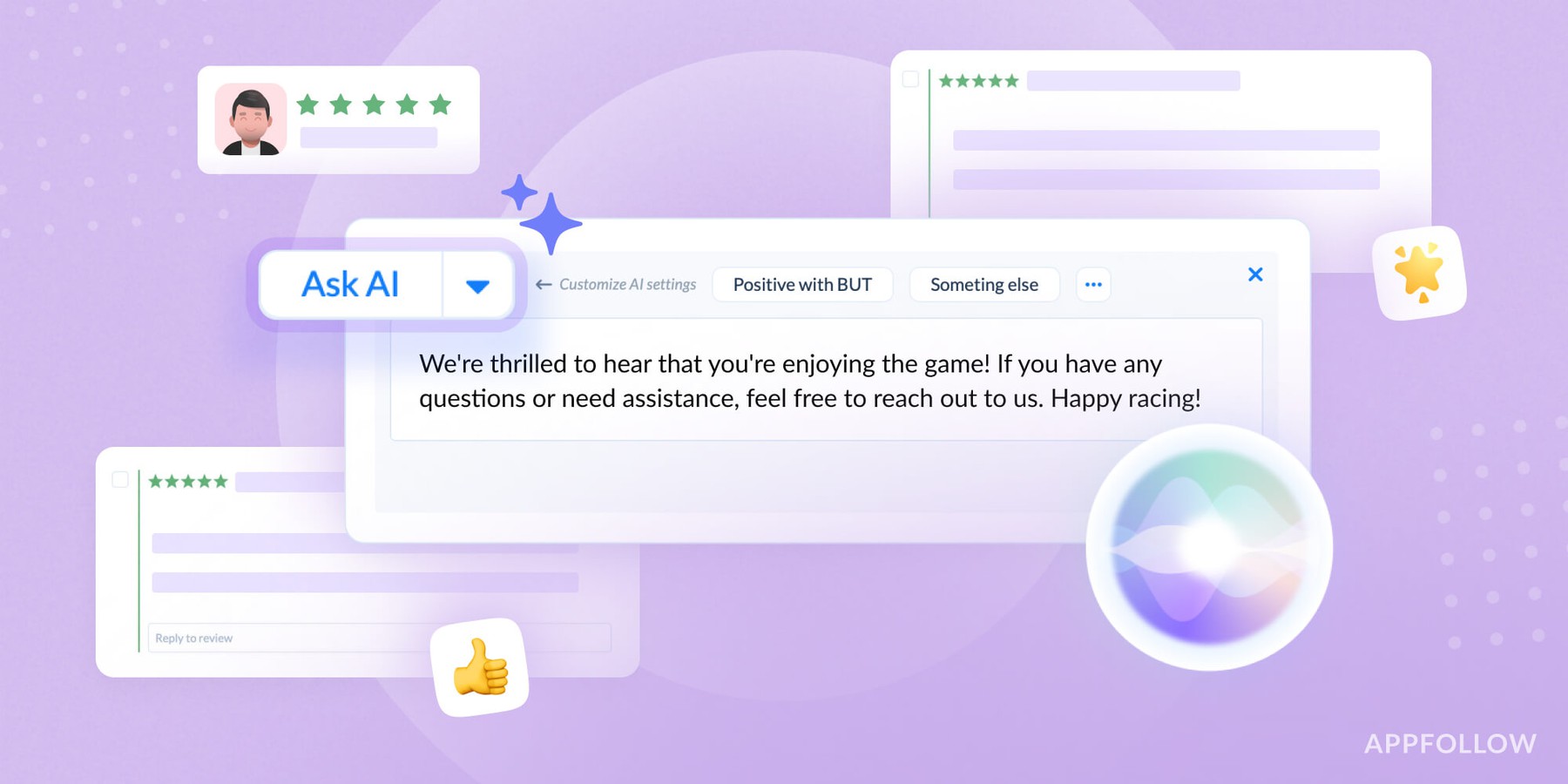
AppFollow is an AI-powered platform designed to help app developers and marketers read and analyze customer reviews from app stores. No more wasting hours scrolling through feedback—this tool digests every review and tells you what needs fixing. It spots problems, identifies trends, and gives you clear action items. Stop drowning in data and start making real improvements.
Features
⚙️ Sentiment analysis to understand the mood behind customer reviews
⚙️ Review categorization for organizing feedback into themes like bugs, features, or UX
⚙️ Customizable filters to zero in on customer feedback based on ratings or keywords
⚙️ Multilingual support to read reviews from customers worldwide
⚙️ Real-time monitoring of new reviews and feedback
Pricing and trial

AppFollow offers a free trial, with paid pricing plans starting at $179/month. Perfect for small teams and growing apps.
cta_free_trial_yellow
Medallia Text Analytics: for enterprise customer-experience programs

Medallia belongs on the shortlist when feedback analysis sits inside a larger CX operation: surveys, digital interactions, contact-center signals, and service processes. Teams buying it are usually deciding how insights move across departments, not looking for a lightweight app-review inbox.
The old MonkeyLearn name still appears in comparisons. Medallia acquired the company in 2022, but that does not mean a former standalone MonkeyLearn plan is available today or that every historical capability maps directly to the current suite.
Best for: enterprises already using a structured experience-management program.
Limit: expect a broader implementation and a quote-based buying process. Verify the exact text-analytics module, integrations, user permissions, and commercial scope in a live demo. Do not reuse archived MonkeyLearn prices.
Revuze

Revuze is worth evaluating when a brand wants to compare product feedback across retailers rather than only manage a review inbox. In the demo, ask for an aspect-level breakdown for one SKU across two supported retailers. Can you trace a complaint back to the exact review and separate product quality from delivery issues? Confirm data-source coverage before buying; “every marketplace” is not a defensible promise.
Features
⚙️ Sentiment analysis to gauge overall customer satisfaction
⚙️ Trend detection to see how customer feedback evolves over time
⚙️ Customizable dashboards for a personalized view of your customer reviews
⚙️ Multilingual support for reading reviews in different languages
Pricing and trial
Revuze offers custom pricing based on your business needs (and the size of your wallet!). They also provide a demo on request to see the AI magic in action before committing.
Yotpo

Yotpo is the practical shortlist candidate when review collection and analysis sit beside a store’s customer and commerce workflows. The purchasing test is whether review themes can be segmented by your product catalog and acted on by the team already working in Yotpo. Verify which third-party review sources are actually available. A Shopify integration does not automatically mean you can analyze every retailer’s reviews.
The pitch is "reviews + the rest of the Yotpo stack," so if you also run Yotpo for loyalty, SMS, or UGC, the customer signal is already joined up across channels. Not the right pick if your reviews live mostly on retailers Yotpo doesn't ingest from yet.
Features
⚙️ AI-powered sentiment analysis to understand how customers feel about your products
⚙️ Review aggregation to bring all your customer feedback into one place
⚙️ Trend tracking to spot patterns in customer reviews
⚙️ Seamless integration with e-commerce and app platforms
Pricing and trial

Yotpo provides custom pricing tailored to your business. They also offer a free trial for new users.
Thematic

Thematic is aimed at people who need to explain why a theme matters, not just show a positive/negative split. Ask to see how an analyst inspects, corrects, and exports theme assignments. If your team runs recurring qualitative research across surveys and reviews, that control may matter more than the ability to post replies from the same screen.
Read also: this guide has the online reputation management strategies you need. Don't sleep on it.
Features
⚙️ Sentiment analysis to get a quick snapshot of how customers feel
⚙️ Topic categorization for easy feedback organization
⚙️ Trend detection to spot recurring issues or praise
⚙️ Visual dashboards that provide easy-to-read insights from customer reviews
Pricing and trial

Thematic offers custom pricing based on the size and needs of your business starting from 25k/year. You can also request a demo to see how it handles customer feedback.
cta_free_trial_purple
ReviewTrackers

ReviewTrackers is a better-fit conversation for businesses comparing customer feedback across locations and public review sites. Try it with reviews from several branches: which location is driving the complaint and how fast can the right manager see it? If your core problem is app-version bugs and store-specific ratings, test that workflow explicitly rather than assuming a location-first product will cover it.
Features
⚙️ Sentiment analysis to break down the tone of customer reviews
⚙️ Review aggregation to collect feedback from various platforms
⚙️ Customizable reports to view and act on customer feedback trends
⚙️ Real-time monitoring for staying up-to-date on new customer reviews
Pricing and trial

ReviewTrackers offers pricing plans starting at $59/month, and they provide a free demo to help you explore the tool’s features before subscribing.
Amplitude AI Feedback: for product teams already working with behavior data
Amplitude launched AI Feedback in November 2025 to turn open-ended customer input into themes and product insights. Its appeal is the connection to a wider product-analytics workflow: teams can investigate what users complain about alongside how people interact with a product.
Best for: product organizations that already work in Amplitude and want qualitative feedback closer to behavior analysis.
Limit: do not assume every app-store, marketplace, or support integration is included. Ask which sources the current AI Feedback offering accepts, how reviews are matched to product context, and what a team can export or route to engineering.
Pricing: Request current terms or check Amplitude’s product documentation. The original launch announcement establishes the product’s existence, not today’s plan limits.
Oh, looks like we’re all out of arch-nemeses (nemessi?). In fairness, proper research will always involve shopping around and seeing who’s good and who’s not. Do yours, and pick the best.
Give every finalist the same 100 reviews
Do this before the contract, not after onboarding. Export 100 reviews you are allowed to use, remove personal data, and include a mix of short praise, mixed sentiment, repeated bugs, niche terminology, and two languages your team actually supports. Have a human reviewer mark the topics and priority in advance.
Then ask each vendor to classify the same set. Check whether it catches the known high-risk issues, where it invents a topic, and how quickly you can correct a bad label. Open the original reviews from the dashboard. If you can’t trace a surprising claim back to source, treat it as unverified.
Finally, ask what the team would do with the result on Monday morning. An impressive cluster chart that nobody can route or export is another report to maintain, not a working feedback loop.
How to turn AI review analysis into a product decision
Here’s a simple release-check workflow. Imagine an app team suspects a new login flow is generating complaints. The numbers below are illustrative; this is a method, not a customer case study.
- Fix the cohort first. Choose one store, a defined date range, and the relevant countries. Include app-version data where the store supplies it. A global summary can hide a local problem.
- Read the AI Summary, then open the source reviews. Search for login failures, password resets, and account lockouts. Check whether the AI grouped distinct issues together.
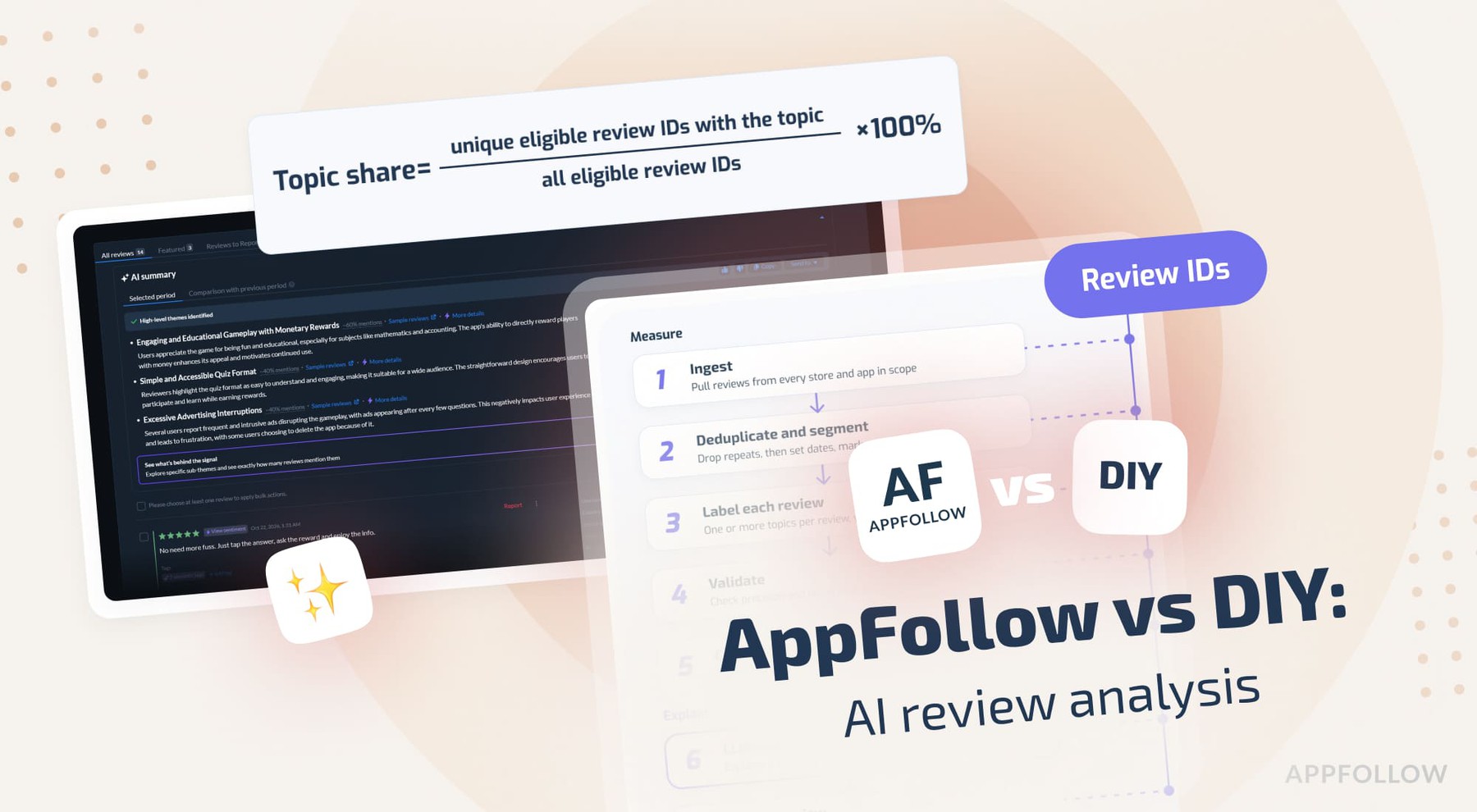
- Compare theme share with the prior matched period. Report both the count and the denominator. A tag can be attached to more than one review, so percentages across tags need not total 100%.
- Send the evidence to the owner. Support needs a reply plan; engineering needs a reproducible symptom, affected version, and linked reviews. Different jobs, same source.
- Recheck after the fix ships. Did the complaint’s share of analyzed reviews fall? Did average review rating for that topic recover? Keep the before/after window and market comparable.
In AppFollow, the relevant places to inspect are the Reviews Feed AI Summary, Semantic Analysis, and Tags Analysis. A semantic label is a clue. The original review is evidence.
cta_get_started_purple
FAQ
Can AI read and summarize customer reviews?
Yes. AI review-analysis tools can group review text by sentiment and topic and surface common complaints. For important decisions, inspect the original reviews and check whether the categories are correct.
What is the best AI tool for App Store and Google Play reviews?
Choose a tool that supports the stores and countries you manage, lets you inspect the source text, and fits your reply and escalation workflow. AppFollow is one option for app-store operations; a cross-channel CX platform may be a better fit when reviews are only one of many feedback sources.
Can I use ChatGPT to analyze exported reviews?
Yes, for a small, permissioned sample. Remove personal information and provide clear categories and a consistent format. For continuous monitoring, you still need a dependable collection process, access controls, repeatable tagging, and a way to route issues to owners.
How accurate is AI sentiment analysis?
There is no universal percentage you should trust across all products. Accuracy depends on the languages, domain, topic taxonomy, and test data. Request a trial on your own labeled sample and check the mistakes that matter operationally.
What should I measure after adopting an AI review-analysis tool?
Track time to identify an issue, how many reviewed tags are correct, theme share before and after a release, routing time, and whether the original reviews support the reported insight. Faster summaries alone are not a business outcome.
Final take
A tool that can read 10,000 reviews is easy to admire. The useful one makes it clear which complaints deserve attention today, what evidence supports them, and who can fix them. Shortlist by channel and workflow. Run the same small sample through your finalists. Then buy the system your team will still open after the demo excitement wears off.
cta_get_started_yellow
Reviewed by Yaroslav Rudnitskiy, ASO Lead at AppFollow